

SUNTAN TECHNOLOGY COMPANY LIMITED · VARISTOR CIRCUIT PROTECTION SOURCING GUIDE
Varistor Selection for Emerging Power Electronics: Safeguarding AI Data Centers, EV Charging, ESS, and Robotics
In contemporary power conversion and distribution systems, grid surges, lightning strikes, and fast semiconductor switching transients present severe hazards to sensitive equipment. As architectures expand in AI Data Center power shelves (PDUs & PSUs), EV fast-charging stations, Solar Photovoltaic/Energy Storage Systems (ESS), and Robotics servo drives, selecting the appropriate voltage transient suppression components is vital to ensure long-term field survivability.
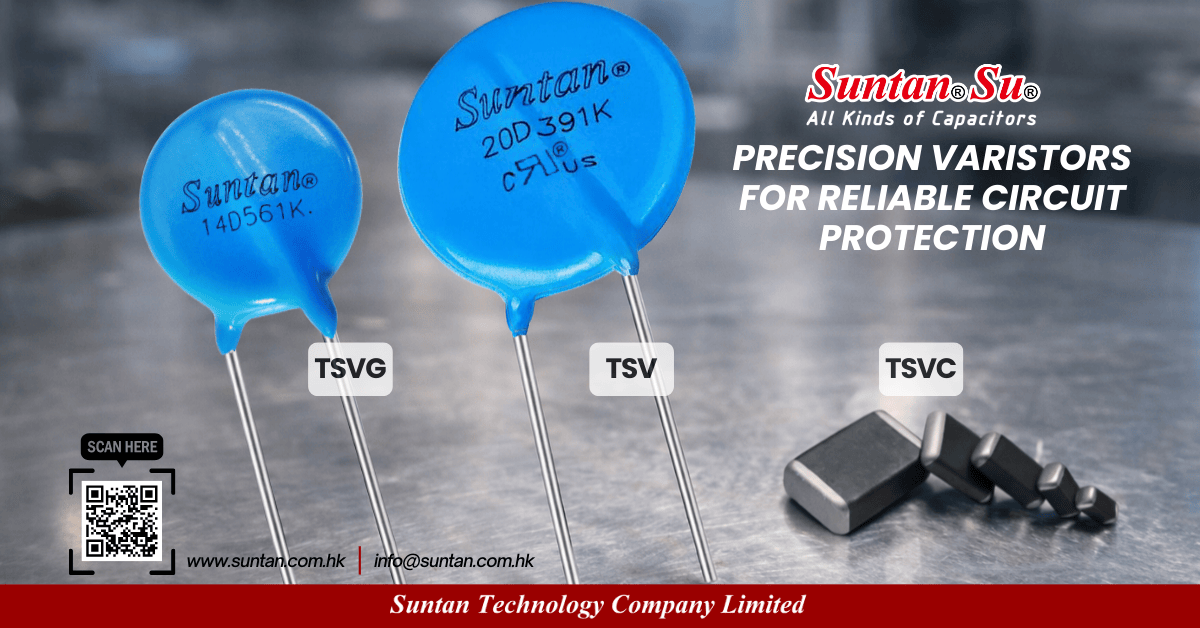
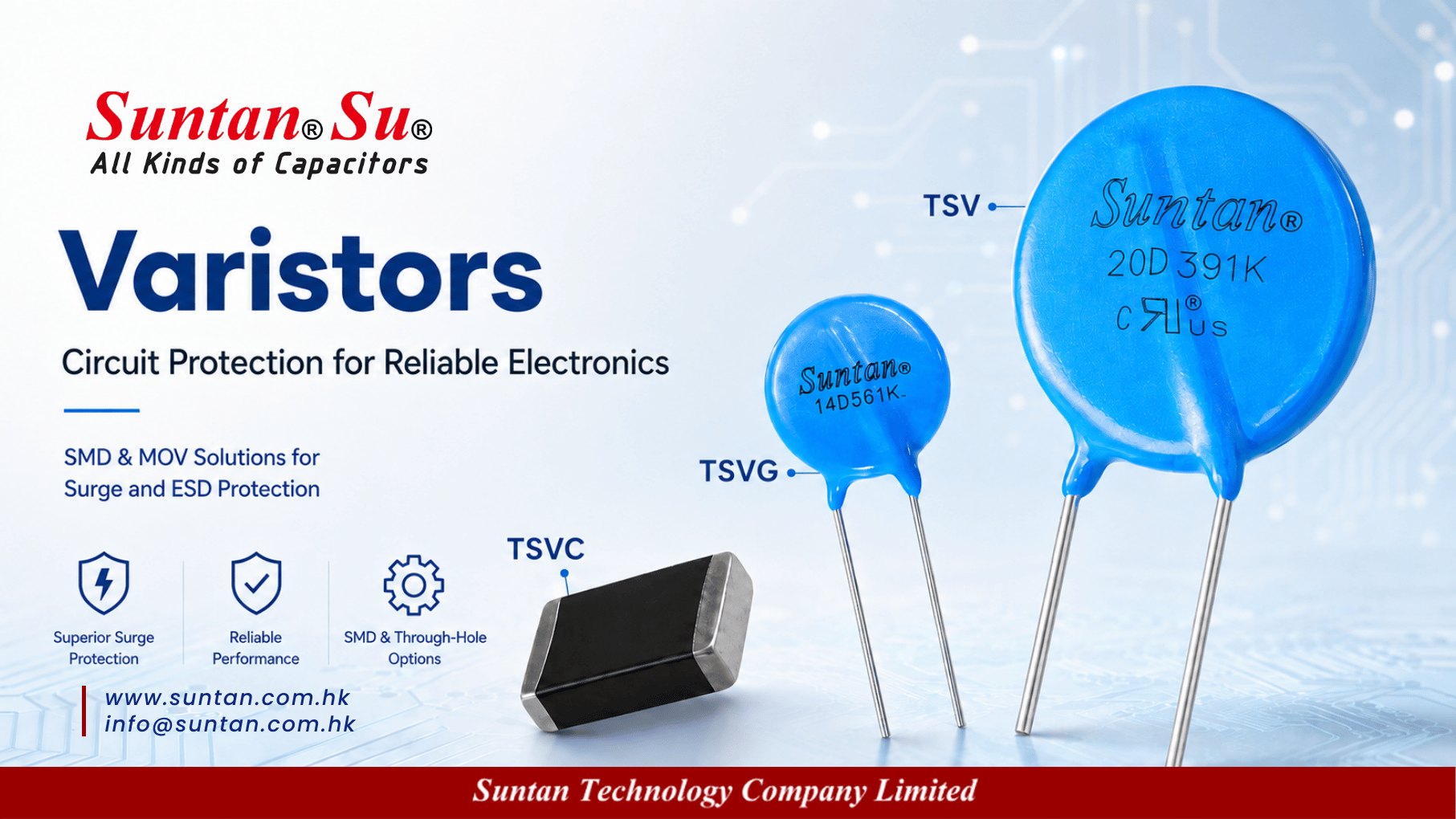
Suntan Technology Company Limited® provides a comprehensive overvoltage circuit protection portfolio: the standard TSV Zinc Oxide Varistor, the upgraded high-temperature & high-surge TSVG Series, and the sub-nanosecond response TSVC Multilayer Chip Varistor (SMD). This engineering guide outlines key selection criteria, disc diameter sizing rules, and datasheet parameters to help design and procurement teams optimize circuit safety.
Transient Protection Demands Across Emerging Power Sectors
- AI Data Centers (48V Bus & High-Power PDUs): High-dynamic GPU compute spikes cause significant AC mains voltage ringing. Radial leaded disc MOVs absorb primary grid transients, while low-capacitance SMD varistors clamp secondary communication lines.
- EV DC Fast Charging Stations: Outdoor environments expose equipment to indirect lightning surges and dynamic DC bus relay kickbacks during vehicle plug-in cycles, requiring high-energy 14D and 20D varistors.
- Solar Inverters & ESS Inverters: High-frequency DC/AC conversion generates inductive back-EMF spikes. Varistors with extended temperature capability (-40°C to +105°C) prevent catastrophic thermal runaway.
- Robotics & Servo Motor Drives: Inductive braking kickbacks require compact overvoltage suppression right at the motor drive terminals and fieldbus I/O nodes.
Suntan® Varistor Series Comparison & Technical Matrix
| Series Platform | Form Factor & Construction | Key Operating Specifications | Primary Application Focus | Datasheet Verification Link |
|---|---|---|---|---|
| TSV Series | Radial Lead Disc MOV (5D, 7D, 10D, 14D, 20D) | V1mA: 18V – 1800V; 8/20 μs Peak: up to 6,500A (20D); Temp: -40°C to +85°C | Mains AC input filtering, SMPS power supplies, home appliances | Download TSV PDF |
| TSVG Series | High-Temp & High-Surge Disc MOV (5D to 20D) | Temp: -40°C to +105°C; Enhanced surge current handling & superior Joule energy absorption | AI data center power shelves, outdoor EV charging, solar PV combiners, robotics | Download TSVG PDF |
| TSVC Series | Multilayer SMD Chip Varistor (0402, 0603, 0805, 1206, 1210) | VDC: 3.3V – 68V; Response Time: <0.5ns; Capacitance <4pF (USB 2.0 compatible); Bi-directional ESD | High-speed data lines (USB, Ethernet, CAN), microcontroller I/O, sensor loops | Download TSVC PDF |
MOV Disc Diameter Sizing Guide (7D, 10D, 14D, 20D)
The physical disc diameter of an MOV dictates its peak pulse current capability (8/20 μs waveform) and total energy absorption (Joules for a 2ms pulse). Balancing surge tolerance against board space is key:
| Disc Diameter | Peak Surge Current (8/20 μs, 1 Time) | Energy Absorption (2ms) | Recommended Application Context |
|---|---|---|---|
| 7D (7mm) | 1,200A – 1,750A | Approx. 9J – 30J | Compact auxiliary power supplies, LED drivers, smart meters, IoT devices |
| 10D (10mm) | 2,500A – 3,500A | Approx. 25J – 70J | Desktop power adapters, home appliances, standard consumer electronics |
| 14D (14mm) | 4,500A – 6,000A | Approx. 50J – 150J | Industrial SMPS, telecom rectifiers, solar microinverters (e.g. 14D471K) |
| 20D (20mm) | 6,500A – 10,000A | Approx. 130J – 360J | Heavy industrial motor drives, EV charging posts, building power entrance (e.g. 20D391K) |
Technical Demonstration Video: MOV & SMD Varistor Manufacturing
People Also Ask: Varistor Selection & Engineering FAQ
What size MOV should I use?
MOV disc diameter (7D, 10D, 14D, 20D) governs peak surge current handling (8/20 μs) and energy absorption (Joules). For compact adapters and small auxiliary circuits, 7D or 10D is standard. For industrial power equipment, outdoor EV charging stations, and AI server power shelves, 14D and 20D models are strongly recommended to endure heavy transient strikes without degradation.
How do I choose a varistor voltage?
Follow a three-step selection procedure: 1) Identify the continuous operating voltage (VRMS for AC or VDC for DC) and add a 15% to 25% safety headroom to prevent premature conduction during normal line fluctuations; 2) Choose a nominal Varistor Voltage (V1mA) matching that threshold; 3) Verify that the maximum Clamping Voltage (VC) at expected peak surge currents remains below the maximum breakdown rating of downstream components.
Is a bigger MOV always better?
A larger MOV disc (e.g., 20D vs. 10D) provides higher surge current capacity, lower thermal stress, and longer operating life under repetitive surges. However, trade-offs include higher component cost, larger PCB footprint, greater height, and increased parasitic capacitance. Hardware designers must balance required surge robustness against physical layout constraints.
What is the difference between an MOV and an SMD varistor?
Radial leaded disc MOVs (Suntan TSV and TSVG) are designed primarily for primary AC and DC power lines to absorb high-energy, high-current surges (in the kilo-ampere range). In contrast, SMD multilayer chip varistors (Suntan TSVC) protect low-voltage secondary circuits and high-speed data interfaces (USB, Ethernet, CAN) against fast-rising electrostatic discharge (ESD) and low-energy transients with sub-nanosecond response times.
What varistor is used for 230V AC mains?
For standard 230V AC utility grids, voltage fluctuations can reach 265V AC or higher. Therefore, the varistor’s continuous maximum AC voltage (VRMS) must be at least 275V to 300V. Common industry choices include nominal 430V or 470V varistor voltage models (such as 14D431K or 14D471K), depending on localized surge test specifications.
What does 14D471K mean?
This standard part number code designates:
• 14D: 14mm disc diameter body size;
• 471: Nominal varistor voltage of 47 × 101 = 470V (measured at 1mA DC);
• K: Voltage tolerance of ±10%.
What does 20D391K mean?
This part number designates a heavy-duty surge varistor:
• 20D: 20mm disc diameter capable of handling up to 6,500A peak surge current;
• 391: Nominal varistor voltage of 39 × 101 = 390V at 1mA;
• K: Tolerance of ±10%. Frequently selected for 220V/240V AC power systems requiring a tight clamping threshold.
How much surge current can an MOV handle?
Surge handling is evaluated using standard 8/20 μs current pulses. Standard 7D discs manage up to 1,200A; 10D discs handle 2,500A; 14D discs handle 4,500A; and 20D discs handle 6,500A or higher. Upgraded TSVG high-surge series provide enhanced pulse endurance and elevated thermal endurance up to +105°C.
Can varistors protect against ESD?
Yes, but selection of the correct construction is critical. While radial MOVs are too slow and excessively capacitive for high-speed data lines, Suntan TSVC Multilayer Chip Varistors are specifically engineered for IEC 61000-4-2 ESD protection, featuring sub-nanosecond response times (<0.5ns) and low parasitic capacitance.
What capacitance should ESD protection have for USB interfaces?
For high-speed communication interfaces like USB 2.0, excessive parasitic capacitance causes severe signal degradation and eye-diagram distortion. According to the Suntan TSVC engineering datasheet, varistor capacitance should be selected below 4pF (with ultra-low capacitance options <1pF recommended for ultra-high-speed differential pairs).
Where should a varistor be placed on a PCB?
A varistor must be positioned as close as possible to the power input connector or entry port, directly downstream of the primary fuse or thermal cutoff. PCB traces connecting to the varistor must be short and wide to minimize parasitic trace inductance, ensuring transient spikes are clamped before propagating into sensitive downstream circuits.
How do I know when an MOV needs replacement?
MOVs experience gradual degradation after absorbing repetitive transient energy pulses. Symptoms of aging include increased leakage current, decreased nominal breakdown voltage (V1mA), and elevated steady-state operating temperature. In severe overstress conditions, visible discoloration or body cracking occurs. Incorporating a series thermal disconnect (TMOV configuration) helps prevent catastrophic short-circuit failures at end of life.
Explore Suntan® Varistor Portfolio Today
Engineering samples, customized lead forming, and bulk pricing are available for worldwide projects.
Suntan Technology · High-Reliability Components Since 1978.
Providing robust zinc oxide varistors, multilayer chip suppressors, capacitors, and bridge rectifiers for global industrial clients.